


The casino floor is an environment designed around human emotion. Bright lights, cascading sounds, and the adrenaline of a winning streak all serve a singular purpose: to coax players into making decisions based on intuition rather than mathematics. Nowhere is this psychological battle more apparent than at the blackjack table.
Unlike pure games of chance like roulette or slot machines, blackjack grants the player agency. Every decision to hit, stand, double down, or split directly alters the mathematical outcome of the hand. Because of this structural design, blackjack is often celebrated as a game that can be beaten, or at least heavily mitigated, through optimal play. The mathematical blueprint for this optimal play is known as blackjack basic strategy. For anyone serious about preserving their bankroll and maximizing their returns, mastering this matrix is entirely non-negotiable.
What is Blackjack Basic Strategy
Blackjack basic strategy is not a betting system, a hunch, or a collection of tips compiled by lucky players. It is a mathematically proven matrix derived from computer simulations that ran hundreds of millions of hypothetical blackjack hands. First conceptualized in the 1950s by a group of mathematicians known as the Baldwin Group, and later refined by IBM scientist Julian Braun using mainframe computers, basic strategy identifies the single most statistically advantageous action a player can take for every possible combination of a player hand and a dealer upcard.
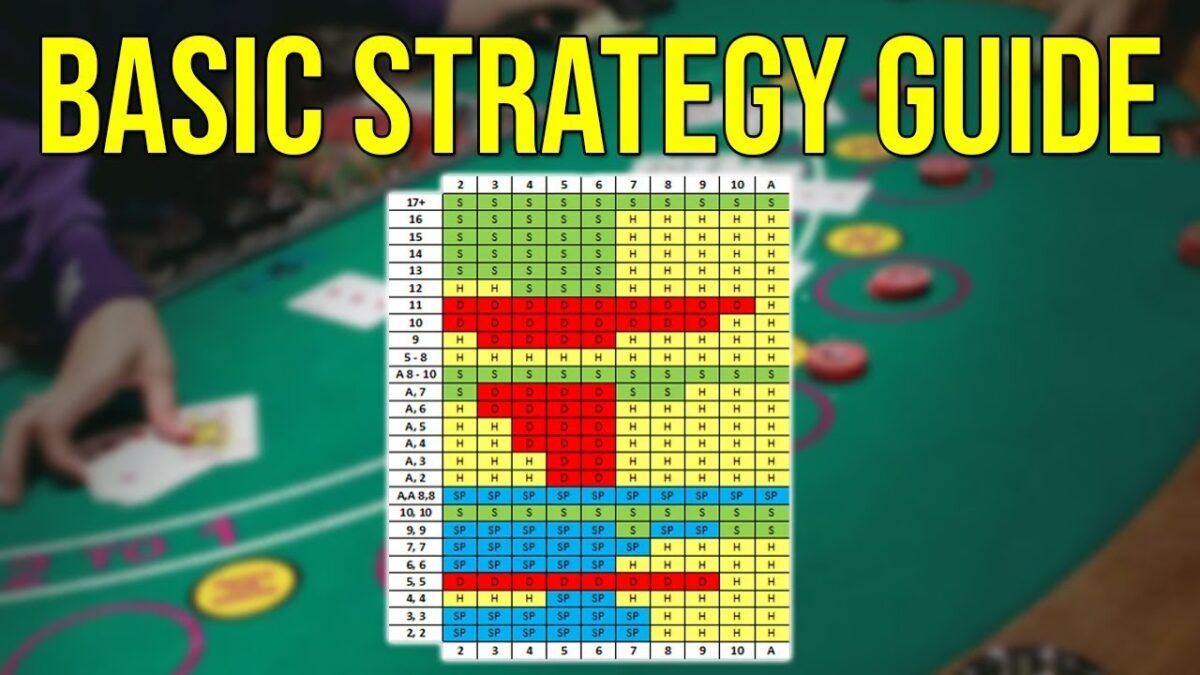
The strategy is typically presented in a grid or chart format, often referred to as the matrix. The vertical axis displays the player total, ranging from hard numbers to soft hands containing an ace and pair splits. The horizontal axis displays the dealer visible upcard, spanning from two through ace. Every intersecting square on the grid dictates a strict, legally mathematically definitive command: Hit, Stand, Double, or Split.
The Core Objective: Minimizing the House Edge
To understand why basic strategy is mandatory, one must understand how casinos generate revenue. Every casino game features an inherent mathematical advantage built in favor of the house, known as the house edge. In blackjack, the house edge exists primarily because the player must act first. If the player busts, they lose their wager immediately, even if the dealer subsequently busts later in the same round.
When a casual player sits down at a blackjack table and plays by instinct, hunch, or fear, they typically give the casino a house edge ranging from two percent to five percent. This means that for every one hundred dollars wagered over time, the player statistically throws away two to five dollars due to suboptimal decision-making.
By adhering strictly to basic strategy, the player drastically shrinks the house edge. Depending on the specific table rules, such as the number of decks used and whether the dealer hits on a soft seventeen, basic strategy reduces the house edge to less than 0.5 percent. Statistically, this levels the playing field, making blackjack the most player-friendly game on the casino floor. Deviating from the matrix, even a single time based on a gut feeling, instantly hands that mathematical advantage straight back to the casino.
Categorizing the Matrix: Hard Hands, Soft Hands, and Pairs
The basic strategy matrix splits all player possibilities into three distinct mathematical categories, each requiring a specific approach to risk management.
Hard Hands
A hard hand is any combination of cards that either does not contain an ace, or contains an ace that must be counted as one point to avoid busting. Hard hands are rigid and highly susceptible to busting. Basic strategy dictates a defensive approach when facing strong dealer upcards like a seven through ace, forcing players to hit until they reach at least seventeen. Conversely, when the dealer shows a weak upcard like a four, five, or six, basic strategy commands players to stand on lower totals like twelve through sixteen, allowing the dealer the maximum statistical opportunity to bust.
Soft Hands
A soft hand contains an ace that can be counted as either one point or eleven points without busting the hand. Soft hands grant the player immense flexibility and offensive power. Many casual players misplay soft hands by standing too early out of fear. Basic strategy leverages the safety of soft hands by aggressively doubling down against weak dealer upcards, allowing players to get more money on the table when the dealer is highly vulnerable.
Pairs
When a player is dealt two cards of identical value, they have the option to split them into two separate hands by matching their original wager. Pair splitting is an offensive tool designed to turn a mediocre starting position into two highly profitable ones, or to minimize damage against a strong dealer card. Basic strategy treats pairs with strict mathematical rules:
-
Always split Aces and Eights, regardless of what the dealer is showing. Splitting aces maximizes the chance of hitting twenty-one, while splitting eights breaks up a highly problematic hard total of sixteen.
-
Never split Tens or Fives. A pair of tens is a starting total of twenty, which is far too strong to dismantle. A pair of fives is a starting total of ten, which is a prime candidate for a double down rather than a split.
The Pitfall of the Intuitive Play
Human intuition is notoriously poor at calculating raw mathematical probabilities in real-time. Casual players often fall victim to cognitive biases that cause them to make devastating errors at the table.
The most common intuitive error is standing on a stiff hand, such as a hard sixteen, when the dealer is showing a ten upcard. The casual player fears drawing a card and busting instantly, preferring to stand and hope the dealer busts. However, basic strategy shows that the dealer holding a ten will make a winning hand the vast majority of the time. While hitting a sixteen against a ten will often result in a bust, it remains the mathematically superior play because it loses less money over a sample size of ten thousand occurrences than standing does. Basic strategy is not about guaranteeing a win on a single individual hand, it is about selecting the option that minimizes long-term financial loss or maximizes long-term financial gain.
Another common pitfall is the misuse of insurance. When the dealer shows an ace, they offer players the chance to buy insurance against a dealer blackjack. Intuition tells the player to protect their hand. Mathematics proves that insurance is a sucker bet with a massive house edge, as the ratio of ten-value cards to non-ten cards in a standard shoe does not justify the payout odds offered by the casino. Basic strategy firmly dictates that a player should never take insurance.
Memorization and Table Charts
Mastering the matrix does not require an extraordinary memory, but it does require disciplined practice. Flashcards, mobile basic strategy trainers, and blank grids can help players memorize the correct actions until they become second nature.
Crucially, land-based casinos do not forbid players from using basic strategy cards at the live table. As long as the card is held in your hand and does not slow down the pace of the game layout, dealers and floor supervisors have no issue with players referencing a physical chart. This is because the casino knows that most players will still abandon the chart during a high-stakes moment due to emotional pressure. The truly disciplined player relies on the chart or absolute memorization, completely unswayed by the shifting energy of the table.
Frequently Asked Questions
Does basic strategy change based on whether other players at the table are playing poorly?
No, the decisions of other players at the blackjack table have zero statistical impact on the long-term mathematical expectation of your hand. A common casino myth claims that a player taking the wrong card at third base can ruin the shoe for everyone else. While this can alter the immediate outcome of a single hand, mathematical tracking proves that poor play by tablemates is just as likely to help your hand as it is to hurt it over time. Your basic strategy decisions remain completely independent.
How do rule variations, like a dealer hitting on a soft seventeen, affect basic strategy?
Minor rule variations require slight adjustments to the basic strategy matrix. When a casino requires the dealer to hit on a soft seventeen instead of standing, it increases the house edge and makes the dealer slightly more dynamic. In this specific environment, basic strategy adjusts by commanding the player to be more aggressive with doubling down on soft hands and splitting specific pairs against a dealer eleven. Always ensure the strategy chart you study matches the exact rules of the table you intend to play.
Why is the payout of three-to-two versus six-to-five blackjack so important for basic strategy players?
The payout structure for a natural blackjack is the single most critical variable affecting your overall return. Traditional tables pay three-to-two, meaning a ten-dollar wager wins fifteen dollars on a blackjack. Modern tables frequently offer a six-to-five payout, meaning a ten-dollar wager wins only twelve dollars. This subtle shift increases the house edge by roughly 1.4 percent, completely wiping out the mathematical advantage gained by executing perfect basic strategy. Serious players should completely avoid six-to-five tables.
Is basic strategy the same as card counting?
No, basic strategy and card counting are entirely distinct concepts. Basic strategy assumes that the composition of the remaining deck or shoe is completely unknown and perfectly random, providing the optimal play based solely on the current static cards visible on the table. Card counting is an advanced technique where a player tracks the ratio of high cards to low cards remaining in the shoe, allowing them to temporarily deviate from basic strategy and increase their bet sizes when the shoe becomes highly favorable to the player.
Can I use basic strategy to guarantee a profit in a short casino session?
No, basic strategy cannot overcome short-term variance. Over a period of a few hours or a single weekend, anything can happen due to pure luck. A player executing flawless basic strategy can still suffer a losing session if they experience a run of poor cards. Basic strategy is designed for sustainability over thousands of hands, smoothing out the peaks and valleys of variance to ensure your bankroll survives and you play at the lowest possible cost to the house.
What should a basic strategy player do when the casino offers a surrender option?
If a table offers late surrender, a basic strategy player should enthusiastically utilize it in highly specific scenarios. Surrender allows you to forfeit your hand immediately in exchange for recovering half of your original wager. Basic strategy dictates surrendering a hard fifteen against a dealer ten, or a hard sixteen against a dealer nine, ten, or ace. This rule allows you to save substantial amounts of capital on hands that possess an incredibly low probability of winning.