
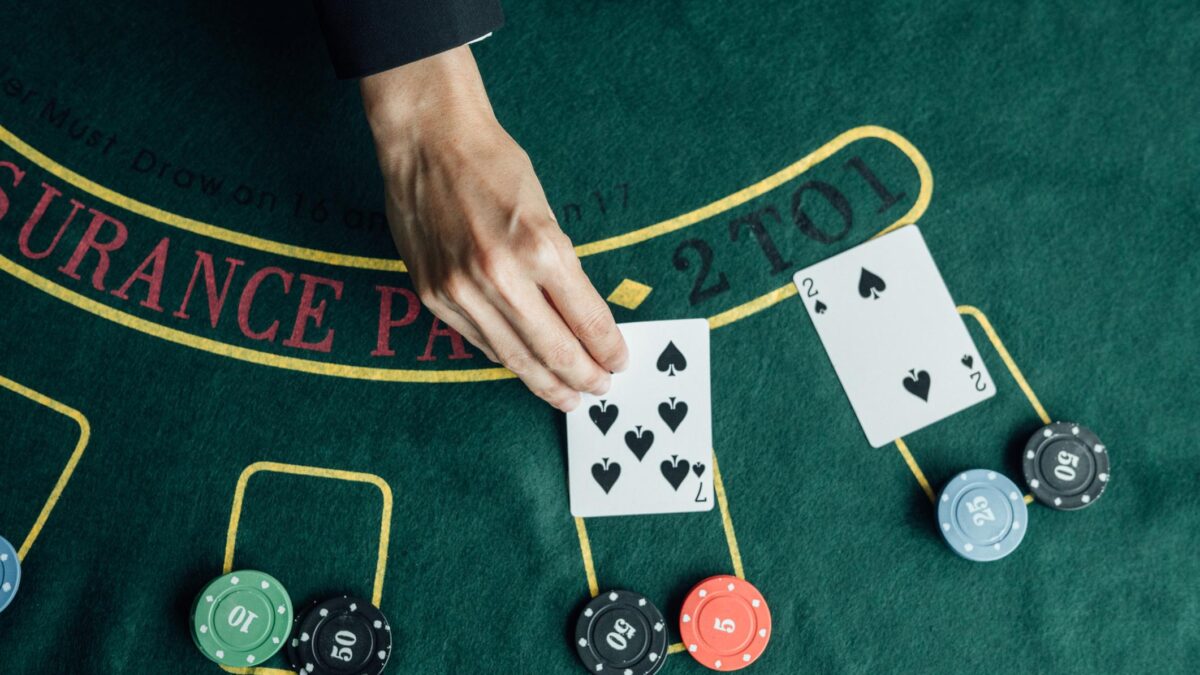


Blackjack is one of the most strategic and beginner-friendly card games in casinos and online platforms. Unlike many games based purely on chance, blackjack rewards decision-making, observation, and discipline. With the right approach, even beginners can quickly develop habits that resemble professional-level play.
This guide explains the fundamentals, essential strategies, and smart habits that help new players play blackjack with confidence and control.
Understanding the Objective of Blackjack
The goal in blackjack is simple:
Beat the dealer’s hand without going over 21.
Each player competes only against the dealer—not other players at the table.
Card values are straightforward:
- Number cards = face value
- Face cards (King, Queen, Jack) = 10
- Ace = 1 or 11 (depending on which benefits the hand)
A starting hand totaling 21 (Ace + 10-value card) is called a blackjack and usually pays higher than standard wins.
How a Typical Blackjack Round Works
Knowing the flow of the game helps reduce hesitation during play.
A standard round follows this sequence:
- Players place their bets
- Two cards are dealt to each player
- The dealer receives one face-up and one face-down card
- Players choose actions such as hit, stand, double down, or split
- Dealer reveals their hidden card
- Dealer draws cards based on fixed rules
- Winners are determined
Understanding this structure builds confidence quickly 🎯
Learn the Most Important Player Decisions
Strong blackjack players rely on correct choices rather than guesses.
Hit
Choose hit when you want another card to improve your total.
Best used when:
- Your hand total is low
- Dealer shows a strong card like 9, 10, or Ace
Stand
Choose stand when your hand is strong enough.
Common example:
Standing on 17 or higher is often the safer move.
Double Down
Doubling means:
- You double your bet
- Receive only one additional card
Usually recommended when:
- Your total equals 10 or 11
- Dealer shows a weaker card
Split
Splitting turns matching cards into two separate hands.
Often effective when holding:
- Two 8s
- Two Aces
Avoid splitting 10-value cards since 20 is already a strong total.
Understand the Dealer’s Advantage
Professional-style blackjack play begins with understanding dealer rules.
Dealers must:
- Hit until reaching at least 17
- Follow fixed table rules
- Avoid strategic decision-making
This predictability allows players to make smarter choices based on probability rather than instinct.
Use Basic Strategy Instead of Guessing
Basic strategy charts are built using mathematical probability. Following them reduces the house advantage significantly.
Examples include:
- Always hit when your total is 11 or lower
- Stand on 17 or higher
- Split Aces and 8s
- Avoid splitting 5s and 10s
Even partial use of basic strategy improves outcomes over time 📊
Manage Your Betting Budget Carefully 💰
Skilled blackjack players treat bankroll management as part of strategy—not an afterthought.
Practical guidelines include:
- Decide a spending limit before starting
- Use small, consistent bet sizes
- Avoid increasing bets after losses
- Stop playing when limits are reached
Controlled betting keeps the game enjoyable and sustainable.
Avoid Insurance Bets as a Beginner
Insurance is offered when the dealer shows an Ace.
Although it may sound protective, it usually benefits the house more than the player.
Most experienced players recommend skipping insurance unless using advanced card-counting techniques.
Pay Attention to Table Rules Before Playing
Not all blackjack tables operate the same way.
Rule variations can influence results, such as:
- Whether the dealer hits or stands on soft 17
- Number of decks used
- Availability of doubling after splits
- Blackjack payout ratios
Choosing tables with favorable rules improves long-term outcomes.
Practice Recognizing Strong vs Weak Dealer Cards
Reading the dealer’s visible card is one of the most important beginner skills.
Generally:
Weak dealer cards
- 2 through 6
Strong dealer cards
- 7 through Ace
When the dealer shows a weak card, players can often play more conservatively and let the dealer risk busting.
Stay Calm and Avoid Emotional Decisions 🧠
Consistency separates casual players from confident ones.
Avoid:
- Increasing bets after losses
- Playing faster than comfortable
- Ignoring strategy during winning streaks
- Trying to recover losses quickly
Calm decisions lead to better results over time.
Practice Before Playing Real-Money Games
Free blackjack versions allow beginners to:
- Learn table flow
- Test strategies
- Build confidence
- Understand timing
Practicing first reduces mistakes when moving to real-money tables.
FAQ: Beginner’s Blackjack Questions Answered
1. Is blackjack mostly luck or skill?
Blackjack combines both, but strategy plays a larger role compared to many other casino games.
2. What is a “soft hand” in blackjack?
A soft hand includes an Ace counted as 11, giving flexibility without immediate risk of busting.
3. Does the number of decks affect the game?
Yes. Fewer decks generally improve player odds slightly compared to multi-deck games.
4. Should beginners play live dealer blackjack or digital tables first?
Digital tables are often easier for beginners because they move at a slower pace and allow more time to decide.
5. What is the safest starting bet size?
Many beginners start with small fixed bets equal to about 1–3% of their playing budget.
6. Can players leave the blackjack table anytime?
Yes. Players can usually stop after any completed round without penalty.
7. How long does it take to learn basic blackjack strategy?
Most beginners become comfortable with core strategy decisions after a few practice sessions.